

If you’ve ever wondered, “Am I doing enough to protect my child from the food and body hell I’ve been through?” this workshop series will give you the grounding you need: education, a framework to lean on, and concrete practices you can use to build a truly body-positive home.
Here’s what to expect:
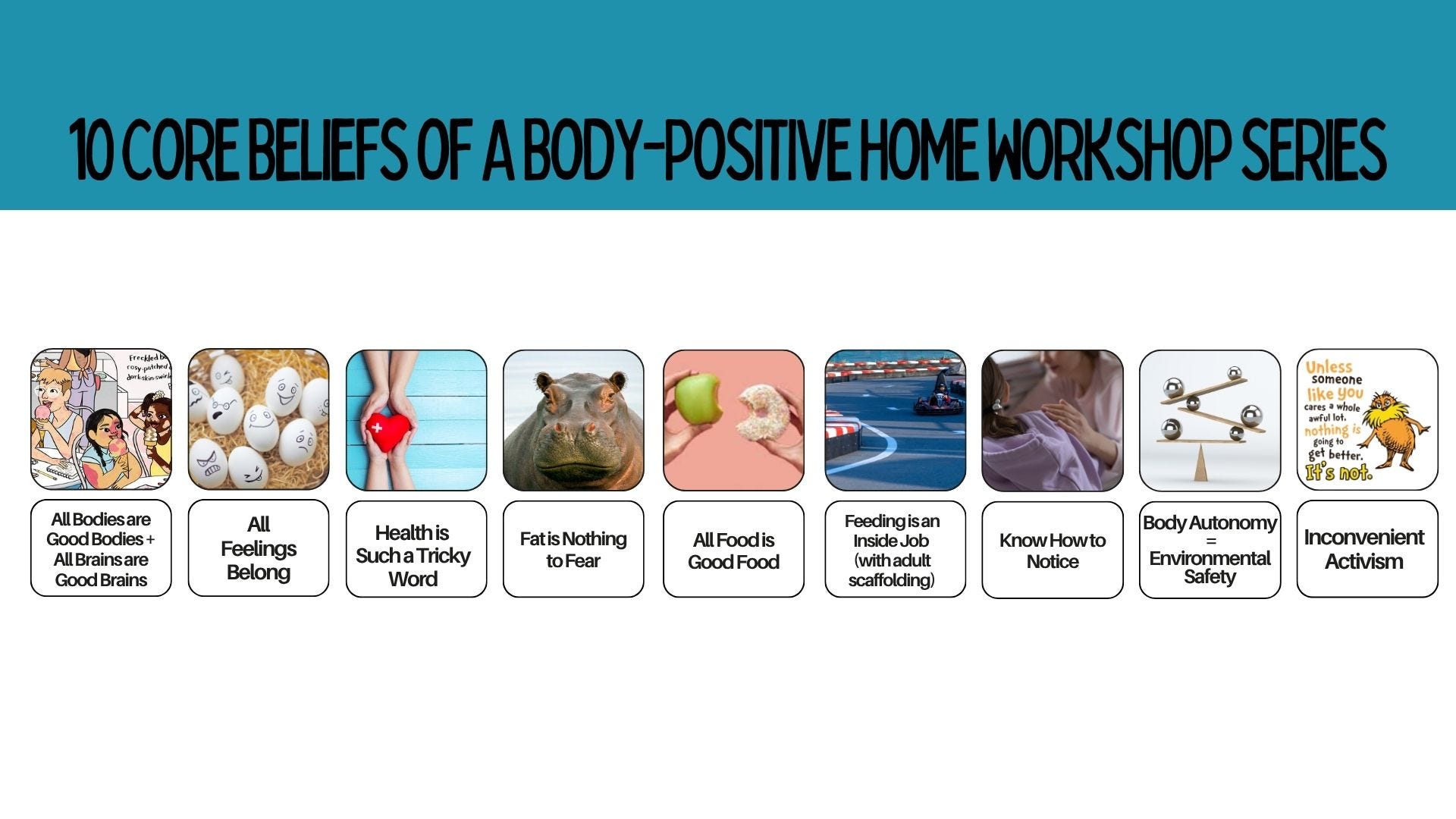
9 workshop replays outlining 10 Core Beliefs that every Body-Positive Home is built on
Practical guidance to build a family culture that is primed to maximize protections for your child’s relationship with food and body
Clear, research-informed psychoeducation about body image and eating disorder prevention.
Practical, real-life steps you can start using right away to strengthen your child’s relationship with food and body (and repair your own, too).
Oh, and with the current Summer Sale discount, this is all yours for $48 (or $8/month)!
Here’s the full roadmap:
Disclaimer: This workshop series is not a substitute for therapy. If you are seeking therapy or need professional support, please consult a licensed mental health professional.
Belief #1 and #2

In this session we discuss:
Discover the two most critical Core Beliefs that every Body-Positive Home is built on
Use them to establish a family culture that is primed to maximize protections for your child’s relationship with food and body
Receive clear, research-informed psychoeducation about body image and eating disorder prevention.
Real-life steps you can start using right away to strengthen your child’s relationship with food and body (and repair your own, too).
Belief #3

In this session we discuss:
Learn about the special role feelings play in the development and nurturing of body image — with emphasis on eating disorder prevention and healthy coping.
Gain understanding about common feedback loops between food, body, and emotions in kids and parents — and how they can either fuel shame or foster emotional resilience.
Discover new ways to nurture self-trust in kids — the root of resilience in food, body, and beyond.
Lay foundations for long-term protection — against eating and body image struggles, and also anxiety, depression, and other mental health challenges.
Belief #4

In this session we discuss:
What families really mean when they say they “just want their kids to be healthy”
Why “healthy weight” is such a complicated concept—and one we all need to understand
How to talk about family health histories without creating body anxiety or moralizing food
Simple, practical ways to boost kids’ intrinsic motivation to care for their bodies
How to model balanced, sustainable health habits without shame or pressure
Belief #5

In this session we discuss:
How unchecked anti-fat bias increases risk for body image disturbances, eating disorders, and disordered eating
How increasing comfort with fatness can be deeply health promoting
Practical strategies to unlearn anti-fat bias
How to navigate flash-point moments when kids say, “I’m so fat” or “Am I fat?” with responses that build connection and decrease shame.
How nurturing fat acceptance nurtures body-image resilience—helping kids feel safer in their bodies, buffer against appearance pressures, and stay more grounded even when trends, peers, or algorithms tell them their body is a problem.
Belief #6

In this session we discuss:
How to set up a home food culture that reduces fixation and supports a healthy long-term relationship with food.
How to talk about food and nutrition in developmentally appropriate ways, so our language supports learning and safety rather than confusion, shame, or control.
How food neutrality acts as an eating-disorder prevention strategy, by interrupting moralization, fear, rigidity, and secrecy before they take root.
How to support kids in trying new foods over time, without force, bribery, or power struggles.
How to use food as a vehicle for connection, closeness, and relationship, not just fuel, rules, or something to manage.
How your own relationship with food can function as a protective or risk factor for your kids
Belief # 7

In this session, we’ll discuss:
Why “Eating is an inside job (with adult scaffolding)” is a core belief for families wanting to nurture a healthy relationship with food
How to build body trust in kids of all sizes through the way we feed
How to keep pressure, negotiation, and power struggles out of mealtimes
How family feeding norms can function as eating-disorder prevention
How to use food and meals as vehicles for closer parent-child relationships
How to manage common parent triggers (kids eating “too much,” “too little,” “no vegetables,” “too many snacks,” etc.)
How to tell the difference between a teachable eating moment and a more pervasive problem
How your own relationship with food can act as either a protective factor or a risk factor for your child
Belief # 8

In this session we discuss:
The different ways eating disorders can show up in children and teens (including the ones that don’t raise immediate alarm)
Why early detection matters more than most parents realize—and what’s at stake when concerns are missed
How to make sense of risk factors without spiraling or second-guessing yourself
The early signs of struggle that are easy to overlook
What to say (and what not to say) when something feels off
How to determine when a concern warrants professional evaluation—and what kind of support to seek
How to make sure the professionals you consult truly understand eating disorders—and won’t miss or minimize what you’re seeing (sadly this happens a lot!)
Belief # 9

In this session we discuss:
How to understand why body autonomy is foundational to self-actualization—and why it matters for both parents and kids
How to recognize the implicit messages our personal choices send about bodies, food, health, and worth within a shared family environment
How to navigate common conflicts of interest that arise when a parent’s needs, values, or choices don’t neatly align with what may feel safest or most protective for a child’s emerging body image/relationship with food
How to conduct a thoughtful cost–benefit analysis when autonomy and environmental safety are in tension
How to identify and reduce potential harm while still honoring your right to make decisions about your own body (special focus on intentional weight loss, fitness identities, or dietary restrictions)
Belief # 10

In this session we discuss:
How to identify common diet culture hot spots in relationships with grandparents, teachers, coaches, pediatricians, and other trusted adults
How to tolerate the discomfort that can arise when protecting your child’s relationship with food and body requires speaking up
How to advocate clearly and interpersonally effectively without immediately escalating conflict or damaging important relationships
How to balance preserving connection with grandparents, schools, and healthcare providers while still protecting your child’s body trust and emotional safety
Bonus

Mara Gordon, MD is an anti-diet doctor and writer who’s Newsletter, Your Doctor Friend, I highly recommend. We had a wonderfully nuanced discussion about what weight-neutral healthcare actually entails for the whole family, the importance of positive early experiences at the doctor’s office, and how to increase the likelihood that you’re providing it if you’re a clinician—and getting it if you’re a parent advocating for your kids and/or yourself.
And if a paid subscription is not right for you right now, liking and sharing this post is a wonderful way to support my work too!
All content shared here is protected under applicable copyright, trademark, and other proprietary rights. It is intended for informational and educational purposes only and should not be considered a substitute for professional, medical, or psychological advice, diagnosis, or treatment. Engaging with this content does not establish a professional or therapeutic relationship. If you have concerns about your or your child’s health, mental health, or safety, please consult a qualified medical or mental health professional.